
Porsche 911 Turbo vs. Carrera: Which One Should You Buy?
Introduction: The Eternal Porsche Dilemma
The silhouette is unmistakable—that swooping roofline, those pronounced rear haunches, the classic circular headlights. The Porsche 911 has maintained its iconic design language for nearly six decades while continuously evolving underneath. Among the numerous variants in the 911 family, two names stand out as pillars of the lineup: Turbo and Carrera.
I still remember my first encounter with a 911 Turbo, a midnight blue 993 generation parked outside a café in Monaco. The owner caught me admiring its muscular stance and invited me to hear it start up. The sound was intoxicating—mechanical yet melodic, powerful yet refined. Years later, when I had the chance to drive a modern Carrera through the winding roads of the Bavarian countryside, I understood why the 911 has earned its legendary status.
But which one should you buy? The answer isn’t as straightforward as comparing price tags or horsepower figures. These cars represent different philosophies within the same bloodline—one a precision instrument for everyday driving pleasure, the other a technological tour de force pushing the boundaries of what’s possible in a road-legal sports car.
In this comprehensive guide, we’ll explore both models in depth, examining their historical significance, performance capabilities, driving experiences, practicality, and ownership costs. By the end, you’ll have a clear understanding of which 911 variant aligns best with your driving aspirations, lifestyle needs, and budget considerations.
The Heritage: Evolution of Icons
The Carrera Lineage
The Carrera name has deep roots in Porsche’s racing heritage, derived from the challenging Carrera Panamericana race in Mexico where Porsche achieved significant success in the 1950s. Since the early days of the 911, the Carrera has represented the purist’s choice—the core model that embodies the essential 911 experience.
Through the generations, from the air-cooled classics to today’s technological marvels, the Carrera has maintained a consistent philosophy: balanced performance, driver engagement, and everyday usability. The modern Carrera continues this tradition while incorporating contemporary technology and refinement that would have seemed unimaginable to early 911 enthusiasts.
The Turbo Revolution
The 911 Turbo debuted in 1975 as Porsche’s response to changing emissions regulations and the energy crisis. What began as a necessity quickly became the crown jewel of the lineup. The original 930 Turbo, with its whale tail spoiler and explosive power delivery, earned the nickname “Widowmaker” due to its challenging handling characteristics when pushed to the limit.
Over subsequent generations, Porsche engineers tamed the Turbo’s wilder tendencies while continually pushing its performance envelope. The addition of all-wheel drive, electronic driving aids, and eventually twin-turbocharging transformed the model into what it is today: the technological flagship of the 911 range that combines supercar performance with remarkable everyday usability.
Performance Comparison: The Numbers Game
Engine and Power Delivery
The current 992-generation Carrera models utilize a 3.0-liter twin-turbocharged flat-six engine. Yes, even the base Carrera is now turbocharged—a development that initially raised eyebrows among purists but has since proven its merit. The standard Carrera produces approximately 379 horsepower, while the Carrera S bumps that figure to 443 horsepower.
The Turbo, meanwhile, employs a larger 3.7-liter twin-turbocharged flat-six, generating an impressive 572 horsepower in standard form, while the Turbo S unleashes a staggering 640 horsepower. These figures place the Turbo S firmly in supercar territory, capable of accelerating from 0-60 mph in just 2.6 seconds—quicker than many exotic hypercars costing twice as much.
The difference in character between these powerplants extends beyond mere numbers. The Carrera’s engine provides a more linear power delivery with progressive acceleration that builds confidently throughout the rev range. The turbos are well-integrated, offering minimal lag and a smoother driving experience than you might expect.
The Turbo’s additional displacement and more aggressive turbocharging create a different sensation altogether. There’s a momentary pause when you first press the accelerator, followed by a tidal wave of torque that pins you back in your seat. It’s not the peaky, lag-heavy experience of turbocharged engines from decades past, but the power delivery is distinctly more explosive than the Carrera’s.
Transmission and Drivetrain
Both models come equipped with Porsche’s exceptional 8-speed PDK dual-clutch transmission as standard, though the Carrera can be optioned with a 7-speed manual for those who prefer a more engaging driving experience. The Turbo is PDK-only, reflecting its focus on outright performance and technological advancement.
Perhaps the most significant mechanical difference between the models is the drivetrain configuration. While rear-wheel drive is standard on the Carrera (with all-wheel drive optional on the Carrera 4), the Turbo comes exclusively with all-wheel drive. This fundamentally changes how each car puts its power down and handles in various conditions.
The rear-drive Carrera delivers the traditional 911 experience—communicative steering, a lively rear end, and that distinctive feeling of the car rotating around you in corners. The Turbo’s all-wheel-drive system provides unflappable traction and stability, allowing drivers to exploit its enormous power reserves in conditions that would have the Carrera struggling for grip.
Handling and Dynamics
Despite sharing the same basic platform, these cars offer surprisingly different driving experiences. The Carrera feels more nimble and connected, with lighter steering and a more playful character that encourages you to explore its handling balance. It’s the dancer of the pair—graceful, precise, and rewarding of driver skill.
The Turbo, by contrast, feels more planted and serious. Its wider track, larger tires, and more sophisticated aerodynamics give it tremendous grip and stability. It’s the heavyweight boxer—immensely powerful but also technically brilliant, capable of delivering knockout performance with scientific precision.
Both cars feature Porsche’s exemplary chassis tuning, but they prioritize different aspects of the driving experience. The Carrera leans more toward communication and involvement, while the Turbo emphasizes capability and confidence.
The Driving Experience: Beyond the Numbers
Daily Drivability
Perhaps surprisingly, both the Carrera and Turbo excel as daily drivers—a testament to Porsche’s commitment to making usable sports cars. The current generation offers remarkable comfort, visibility, and practicality considering the performance on tap.
The Carrera, being slightly narrower and lighter, feels more manageable in urban environments. Its suspension, while firm, strikes an excellent balance between control and compliance, soaking up road imperfections without unsettling the chassis. The standard adaptive dampers can be softened for commuting and firmed up when the road gets interesting.
The Turbo provides a similar breadth of capability but with a greater sense of occasion. Its standard adaptive suspension, featuring more sophisticated hardware than the Carrera’s system, delivers an even more impressive blend of ride quality and body control. However, the wider body and larger wheels make it slightly more cumbersome in tight spaces, and the additional weight is noticeable at lower speeds.
Both cars offer Porsche’s refined stop-start system, cylinder deactivation during light cruising, and reasonably efficient highway consumption given their performance potential. Neither will match an economy car’s fuel efficiency, but they’re far from the gas-guzzling sports cars of yesteryear.
Long-Distance Touring
When the journey extends beyond the daily commute, both 911 variants prove themselves exceptional grand tourers. The supportive seats, excellent driving position, and well-insulated cabins make long trips surprisingly fatigue-free.
The Carrera may have a slight edge in pure comfort, particularly when equipped with the optional front-axle lift system that helps navigate steep driveways and speed bumps. Its more modest power output also translates to slightly better fuel efficiency on long highway stretches.
The Turbo counters with additional standard equipment that enhances long-distance comfort, including more adjustable seats, additional sound insulation, and a more sophisticated climate control system. Its effortless power delivery also makes highway passing maneuvers almost comically easy—a quick squeeze of the throttle is all it takes to execute overtakes that would require a downshift or two in the Carrera.
Track Day Capability
For enthusiasts who plan to explore their car’s limits in a controlled environment, both models offer tremendous capability, albeit with different approaches.
The Carrera, especially in S or GTS form, provides an excellent platform for learning and improving driving skills. Its more approachable limits and communicative nature give drivers confidence to push harder and develop their technique. The optional manual transmission adds another layer of engagement for track purists.
The Turbo raises the performance ceiling significantly. Its massive grip, powerful brakes, and relentless acceleration make it formidably quick in experienced hands. However, its higher limits can be more intimidating for novice track drivers, and its all-wheel-drive system, while incredibly effective, does mask some of the feedback that helps drivers develop sensitivity to weight transfer and grip levels.
Both cars benefit from Porsche’s robust cooling systems and brake designs that resist fade even under heavy track use. The Turbo comes standard with larger carbon-ceramic brakes that provide fade-free stopping power lap after lap, though they’re available as an expensive option on the Carrera as well.
Design and Presence: Making a Statement
Exterior Styling
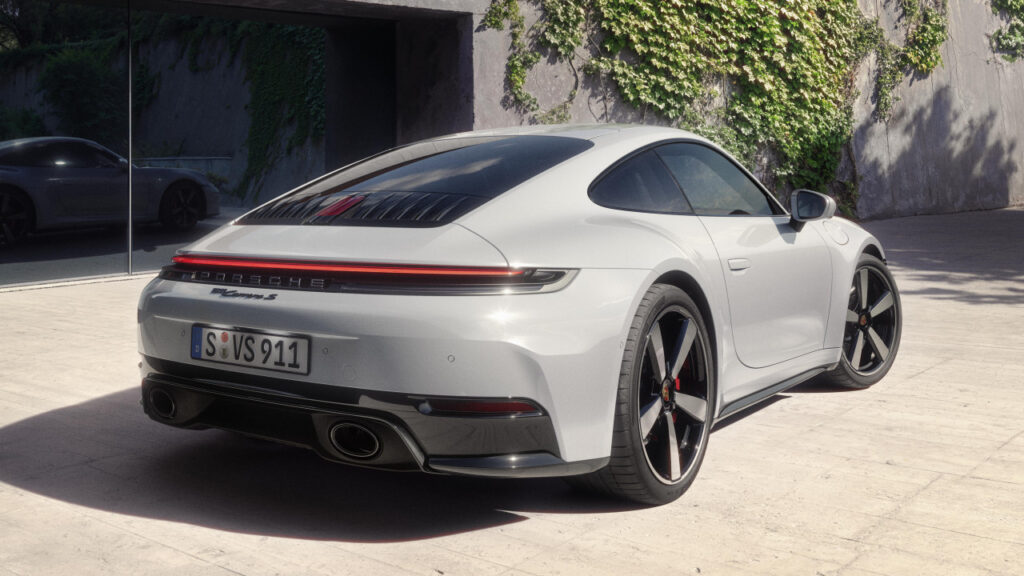
The Carrera represents the purest expression of the 911’s iconic shape. Its clean lines and relatively restrained details allow the fundamental design to shine through. Modern Carreras feature wider bodies than their predecessors, but they maintain a certain elegance and timelessness that has characterized the model for generations.
The Turbo announces its performance credentials more boldly. Its significantly wider rear haunches, larger air intakes, and distinctive side vents ahead of the rear wheels create a more muscular appearance. The standard fixed rear wing (as opposed to the Carrera’s retractable spoiler) and quad exhaust tips further distinguish it from its more modest sibling.
Both cars turn heads, but they do so differently. The Carrera attracts admiring glances from those who appreciate its classic proportions and understated confidence. The Turbo commands attention with its aggressive stance and performance-focused details that hint at the power lurking beneath its skin.
Interior Comfort and Technology
Inside, the differences become more subtle. Both models share the same basic interior architecture, featuring Porsche’s excellent driving position, the five-dial instrument cluster with center-mounted tachometer, and the same high-quality materials throughout.
The Turbo typically comes with more standard equipment, including extended leather trim, more adjustable seats, and additional technology features. However, Porsche’s extensive options list means a well-specified Carrera can match or exceed a base Turbo’s interior appointments—at a price.
Both models feature Porsche’s latest PCM (Porsche Communication Management) infotainment system, which has evolved into one of the better interfaces in the luxury sports car segment. The centrally mounted touchscreen is responsive and logically arranged, while physical buttons for key functions ensure you don’t need to navigate menus for common adjustments.
Practical Considerations: Living With Your 911
Storage and Passenger Space
Despite their performance credentials, both the Carrera and Turbo offer surprising practicality. The front trunk (or “frunk”) provides enough space for a weekend getaway’s worth of soft luggage or several bags of groceries. The rear seats, while not suitable for adults on long journeys, can accommodate children or serve as additional storage space.
The Turbo offers identical cargo and passenger space to the Carrera, maintaining the practical aspects that have long been a 911 hallmark and that distinguish it from mid-engine competitors with more compromised storage options.
Maintenance and Reliability
Porsche has built a reputation for engineering durability into its sports cars, and both the Carrera and Turbo benefit from this commitment to reliability. The current generation of twin-turbocharged engines has proven robust, with fewer teething problems than might be expected from such high-performance powerplants.
Maintenance costs, however, are substantial for both models. Routine service intervals typically occur annually or every 10,000 miles, with major services recommended at 40,000-mile intervals. The Turbo, with its more complex systems and higher performance components, generally incurs somewhat higher maintenance costs, particularly for items like brakes and tires that endure greater stress due to the car’s additional power and weight.
Porsche offers extended warranty coverage that many owners find worthwhile, given the sophisticated technology in these vehicles. Both models also benefit from strong dealer networks in most major markets, though service at independent specialists can provide cost savings once the warranty period expires.
Depreciation and Long-Term Value
The 911 has historically enjoyed stronger residual values than many competitors, partly due to Porsche’s controlled production volumes and the model’s enduring desirability. Both Carrera and Turbo tend to hold their value well, though specific factors affect their depreciation curves differently.
Limited-production variants and special editions typically experience the least depreciation and may even appreciate in value over time. Among standard models, the Turbo has traditionally retained a higher percentage of its initial value, particularly in “S” form, though its higher starting price means the absolute depreciation amount can still be substantial.
The Carrera, with its lower entry price and broader appeal, tends to find buyers more quickly on the secondary market. Manual transmission examples are increasingly sought after as Porsche and other manufacturers move toward automated transmissions across their lineups.
Color and equipment choices significantly impact resale value for both models. Traditional colors like silver, black, and white typically appeal to the broadest audience, while unique paint-to-sample colors may attract enthusiast buyers willing to pay a premium for something distinctive.
The Cost of Ownership: Financial Considerations
Purchase Price and Options
The price difference between Carrera and Turbo models is substantial. In current pricing, a base 911 Carrera starts around $100,000, while the Turbo begins closer to $175,000, with the Turbo S pushing well past $200,000.
However, Porsche’s notorious options pricing means these starting figures can increase dramatically. A well-optioned Carrera S can easily approach or exceed the base price of a Turbo. Popular packages like the Sport Chrono Package, premium audio systems, and advanced driver assistance features can add tens of thousands to the final price.
The Turbo includes many of these features as standard equipment, somewhat offsetting its higher base price. However, it also offers exclusive options that can push its price into supercar territory. Carbon fiber exterior elements, specialty interior treatments, and performance enhancements like the Lightweight Package can add significant premiums.
Insurance and Running Costs
Insurance costs vary widely based on location, driving history, and coverage levels, but the Turbo typically commands higher premiums due to its greater performance potential and higher repair costs. Some insurance companies classify the Turbo in a higher risk category than the Carrera, further increasing the difference in premiums.
Fuel economy, while not typically a primary concern for 911 buyers, shows a noticeable difference between the models. The Carrera, with its smaller engine and lighter weight, can achieve surprising efficiency during highway cruising—some owners report figures approaching 30 mpg in ideal conditions. The Turbo, with its focus on performance, typically consumes 20-30% more fuel under similar driving conditions.
Consumable items represent another significant running cost difference. The Turbo’s larger brakes, wider tires, and more complex cooling systems all contribute to higher replacement costs. Additionally, its tremendous power tends to accelerate wear on these components, potentially shortening their service life compared to the more modestly powered Carrera.
Comparison Table: Turbo vs. Carrera At A Glance
| Feature | 911 Carrera | 911 Turbo |
|---|---|---|
| Starting Price | Approx. $100,000 | Approx. $175,000 |
| Horsepower | 379 hp (base), 443 hp (S) | 572 hp (base), 640 hp (S) |
| 0-60 mph | 4.0 sec (base), 3.5 sec (S) | 2.8 sec (base), 2.6 sec (S) |
| Drivetrain | RWD standard (AWD optional) | AWD standard |
| Transmission | 8-speed PDK (7-speed manual optional) | 8-speed PDK only |
| Width | Narrower body | Wider body with distinctive vents |
| Rear Spoiler | Retractable | Fixed wing |
| Character | More nimble, engaging | More powerful, planted |
| Best For | Driving enthusiasts, purists | Technology enthusiasts, outright performance |
| Fuel Economy | Better | Worse |
| Maintenance Costs | High | Very High |
| Exclusivity | Common (for a 911) | Rarer |
| Depreciation | Moderate | Slightly lower (percentage) |
Making Your Decision: Key Considerations
Identify Your Priorities
The decision between Carrera and Turbo ultimately comes down to your priorities as an owner and driver. Consider these questions:
- Do you value driving engagement and feedback above outright performance?
- Will you primarily use the car for daily driving, weekend getaways, track days, or a combination?
- How important is exclusivity and making a visual statement?
- Are you willing to sacrifice some performance for a more approachable price point?
- Do you prefer the purity of rear-wheel drive, or do you value the all-weather capability of all-wheel drive?
Your answers will help clarify which model better aligns with your expectations and requirements.
Test Drive Both (If Possible)
No article, video, or conversation can substitute for the experience of driving these cars yourself. Their characters are distinct enough that most enthusiasts develop a clear preference after experiencing both. Many Porsche dealerships offer extended test drives for serious buyers, allowing you to experience the cars in various conditions.
If possible, drive them back-to-back on the same roads to highlight the differences in character, performance, and usability. Pay attention not just to the obvious performance metrics but to subtler aspects like visibility, comfort, and how connected you feel to the driving experience.
Consider Future Plans
Your intended ownership timeline should factor into your decision. If you plan to keep the car for many years, the Turbo’s additional capabilities might provide more long-term satisfaction as your driving skills develop. Conversely, if you anticipate changing cars every few years, the Carrera’s lower depreciation amount (in absolute terms) might be financially advantageous.
Consider also how the automotive landscape is evolving. With electrification becoming increasingly prominent, traditionally powered sports cars like the 911 may become more collectible. Limited-production variants and special editions typically fare best in this regard, but all 911 models may benefit from this trend.
Frequently Asked Questions
Is the Turbo worth the additional cost over the Carrera?
For buyers prioritizing maximum performance, exclusivity, and technological advancement, the Turbo can justify its premium. However, the Carrera delivers 90% of the real-world driving experience at 60% of the price, making it the value choice for many enthusiasts.
Which model is better for someone new to Porsche ownership?
The Carrera provides a more accessible introduction to the 911 experience, with more approachable limits and lower running costs. Its performance remains exceptional by any objective standard while being less intimidating than the Turbo.
Do I need the all-wheel drive offered on the Carrera 4 and standard on the Turbo?
For drivers in regions with severe winter weather, all-wheel drive provides valuable all-season capability. However, modern tires and driving aids make rear-wheel-drive Carreras surprisingly capable in adverse conditions. Many Porsche enthusiasts prefer the driving dynamics and traditional feel of rear-wheel drive when weather permits.
How much does the manual transmission change the Carrera experience?
Significantly. The manual transmission adds a layer of engagement and driver involvement that transforms the character of the car. While objectively slower than the PDK automatic, many enthusiasts find the manual more rewarding and enjoyable on scenic drives and winding roads.
Are there significant differences in reliability between the models?
Both models share similar core engineering and build quality, resulting in comparable reliability. The Turbo’s more complex systems and higher performance parameters theoretically present more potential failure points, but Porsche’s engineering standards ensure both models deliver excellent long-term durability when properly maintained.
How do these models compare to the GT3, another popular 911 variant?
The GT3 represents a different branch of the 911 family, focused on track performance and driving purity rather than everyday usability or straight-line speed. It features a naturally aspirated engine (unlike the turbocharged Carrera and Turbo), more aggressive aerodynamics, and a more track-oriented suspension setup. The GT3 splits the difference in price between Carrera S and Turbo, but offers a more specialized, less compromising experience than either.
Can the Carrera be upgraded to match Turbo performance?
Aftermarket tuners offer various upgrades that can boost Carrera performance significantly, sometimes approaching Turbo levels. However, the Turbo’s fundamentally different engine, cooling systems, and broader track make it more than just a more powerful Carrera. Factory-engineered integration and warranty coverage are also important considerations that aftermarket solutions cannot fully address.
Conclusion: Two Sides of the Same Coin
After this comprehensive comparison, we return to our original question: Turbo or Carrera—which one should you buy? The answer remains personal, but we can draw some general conclusions to guide your decision.
The Carrera represents the purist’s choice—the essence of the 911 experience distilled into its most accessible form. It offers exceptional performance, engaging handling, and daily usability without the extreme price tag of its more powerful sibling. For many enthusiasts, particularly those who value driver involvement over outright speed, the Carrera (especially in S or GTS form) hits the sweet spot in the 911 range.
The Turbo, meanwhile, stands as Porsche’s technology flagship—a showcase of engineering excellence that delivers supercar performance with everyday usability. Its explosive acceleration, unflappable stability, and distinctive presence make a statement that few other sports cars can match. For buyers seeking the ultimate 911 experience with no compromises in performance or capability, the Turbo remains the pinnacle of the mainstream lineup.
Both cars carry the legacy of the world’s most enduring sports car design, refined over nearly six decades of continuous development. Both deliver driving experiences that few competitors can match, regardless of price. And both represent different interpretations of Ferry Porsche’s original vision—a sports car versatile enough for daily use but capable enough for weekend adventures and occasional track excursions.
The decision ultimately comes down to your personal priorities, driving preferences, and budget considerations. Whichever model you choose, you’ll join a passionate community of enthusiasts united by their appreciation for one of the most iconic and capable sports cars ever created. The 911—whether in Carrera or Turbo form—remains a benchmark against which all other sports cars are measured, a testimony to Porsche’s unwavering commitment to engineering excellence and driving pleasure.
And perhaps that’s the most beautiful aspect of this comparison—there is no wrong choice. Each model excels in its intended role, delivering experiences that create lasting memories and forge deep connections between car and driver. In a world increasingly dominated by automotive commoditization and electrification, the 911 Carrera and Turbo stand as brilliant reminders of why we fell in love with driving in the first place.


